Google Just Showed What Android XR Glasses Can Actually Do, And It Is Impressive
Smart glasses have existed for years, but the real question, what you’d actually use them for daily, has remained unclear.
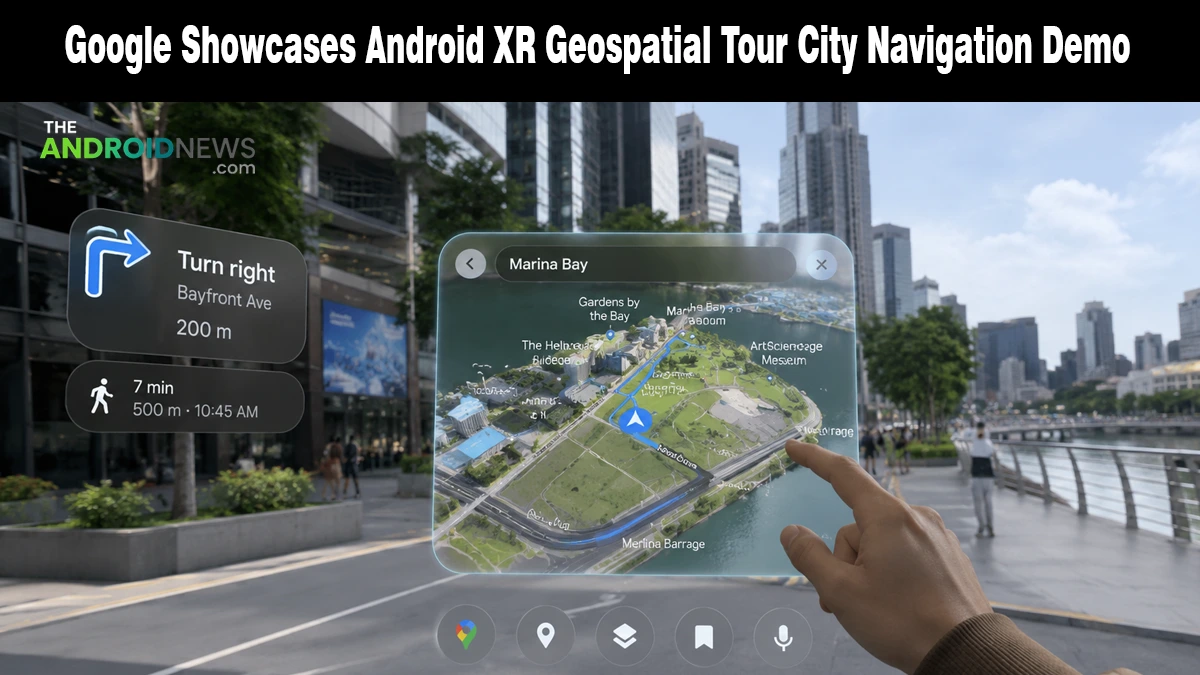
Google addresses this with a new Android XR headset demo, building on the ecosystem teased at Google I/O, showing real-time city navigation with floating 3D arrows anchored to the physical world and points of interest overlaid on streets and buildings.
All this combined with a Gemini-powered voice acting as a human-like tour guide.
Google’s Four-System Architecture
According to Android Authority, Google’s experimental “XR Geospatial Tour” demo combines four systems into a unified pipeline.
- Android XR: Handles mixed-reality rendering and displays spatial overlays in the user’s field of view.
- Visual Positioning System (VPS): Provides centimeter-level spatial localization for precise real-world tracking.
- Google Maps: Supplies routing data and contextual points of interest, including themed walking paths.
- Gemini: Generates and narrates the walking tour in real time using text-to-speech.
VPS first pinpoints the user’s exact real-world position with high precision. Google Maps then builds context-aware walking routes, including thematic options like historical, food, and nature paths.
Gemini turns these routes into live narration, while Android XR renders the experience as 3D directional arrows and contextual overlays anchored to physical landmarks.
Real-World Experience and Hardware Context
The result is navigation that does not require you to look down at a screen of your smartphone at any point. You walk, the world around you updates with the relevant information, and Gemini fills in the story behind each location as you pass through it.
Google specifically frames the demo around the XREAL Aura glasses, the recently confirmed wired Android XR headset from XREAL that features a 70-degree optical see-through display.
The company clarifies that the upcoming audio-only glasses developed with Warby Parker, Gentle Monster, and Samsung cannot run this experience because they lack a visual display layer.
What This Signals for Android XR’s Direction
Navigation is something every phone user uses multiple times a day. Offloading it entirely to a glasses display, with AI narration replacing both screen-checking and earphones, is the first use case that genuinely feels worth wearing on your face.
It also reflects the same pattern Google is pushing across its entire AI stack this year. The COSMO AI assistant demonstrated proactive Skills that act on context without being prompted. Gemini Intelligence is designed to anticipate needs rather than wait for them.
The XR tour guide demo is the same philosophy made spatial: AI that reads the physical environment around you and responds to it instead of waiting for a tap or a voice command.
Source: Building a Mixed-Reality Tour Guide with Android XR, the Geospatial API, and Gemini