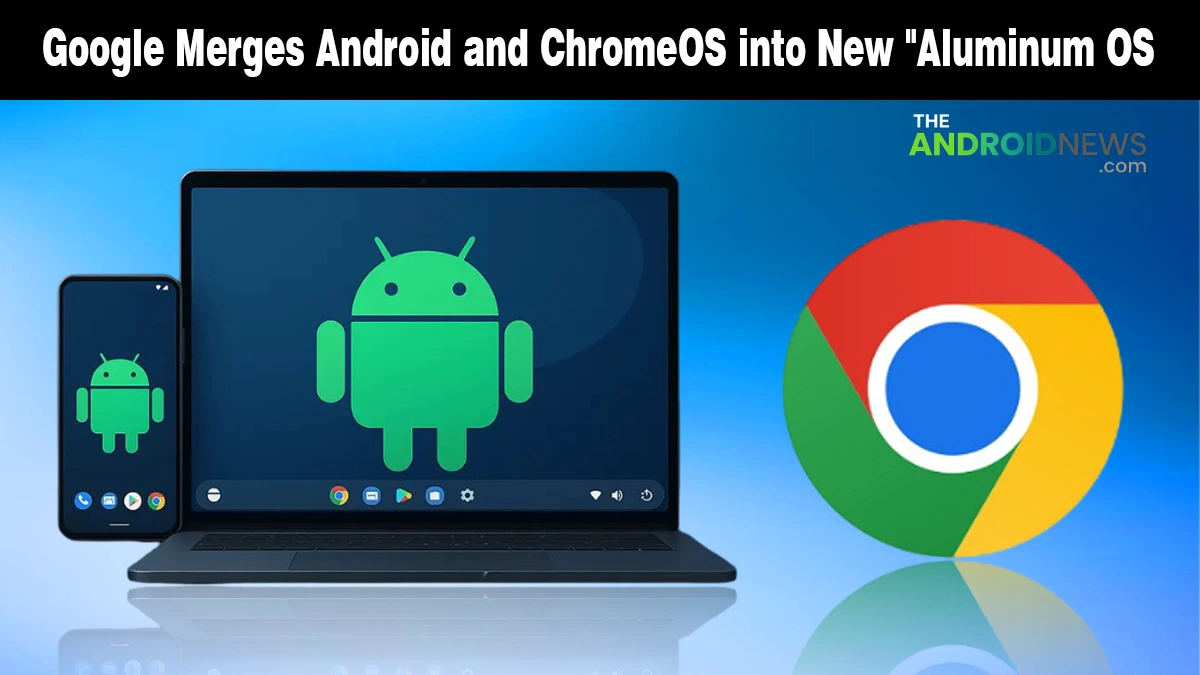
Google Merges Android and ChromeOS to Create the Unified Aluminum OS
For over a decade, Google ran two separate operating systems in parallel. Android powers your smartphones, while ChromeOS powers your Chromebook.
The two coexisted but never truly unified. Different codebases, different design languages, and different ecosystems stitched together with workarounds like the Linux container that let Android apps run on Chromebooks.
That era is ending. Google is merging both platforms into a single unified OS internally called Aluminum OS, and the laptop space is the direct target.
What Aluminum OS Actually Is
According to CNET, Google’s Android Ecosystem head, Sameer Samat, has confirmed that the company is developing Aluminum OS, a merged, single system for desktops, laptops, and detachables, with AI integration at its core.
The architecture replaces the current model where Android runs as a container on ChromeOS. Instead, Aluminum OS is built directly on a hardened Android Linux kernel, making Android the native foundation.
A high-performance version of the Chromium browser runs as an isolated component on top of it, rather than as the operating environment itself.
This approach enables native Android app support on laptops with full cross-device compatibility, aiming for an experience closer to Apple’s ecosystem, where apps run seamlessly across Macs and iPhones through shared frameworks.
And with a Pixel laptop already confirmed in development, Aluminum OS now has its first confirmed hardware home.
The Android Virtualization Framework (AVF) is central to the system. Linux applications and sensitive web workloads run in protected virtual machines (pVMs) with hardware-level memory isolation.
This architecture prevents compromised apps from accessing the host system or other running processes.
The Real Timeline
The timeline becomes more detailed in court documents from Google’s antitrust case, cited by CNET.
They show that Google aimed to release early test builds of Aluminum OS to selected commercial users by the end of 2026. While broader deployment for enterprise and education markets, where ChromeOS is widely used, is expected around 2028.
Google’s lawyers also confirmed in the proceedings that ChromeOS will continue receiving support until at least 2033, aligning with the company’s 2024 commitment to a 10-year update cycle for existing Chromebooks.
A gradual transition is expected after that period, rather than an immediate shutdown or forced migration. For Chromebook users, this means there is no near-term disruption.
For future devices, however, Aluminum OS signals Google’s long-term direction for desktop computing. Qualcomm has already been confirmed as a hardware partner for the first wave of Aluminum OS PCs.
The desktop multitasking refinements landing through recent Android OS updates, improved window management, taskbar behavior, and external display support are laying the software groundwork this platform will rely on.
Why Google Is Doing This Now
The trigger, according to Samat’s remarks, is generative AI. While smartphones and tablets dominated for years, AI-first workflows have renewed focus on large screens, physical keyboards, and multitasking.
Google sees a gap between what Windows 11 and macOS offer and what an AI-native laptop OS could deliver, and Aluminum OS is its response.
Whether Aluminum OS can close that gap in real-world use is a question the Android 17 beta cycle is already beginning to answer. Desktop features are showing up in every build, and they are clearly being built for something bigger than a phone.
Source: Google’s Big Bet: Adding Native Android App Support to Chrome